
Your intake problem is not lead volume. It is the ninety minutes after the form
Most firms we talk to believe they have a lead volume problem. They are spending real money on it, usually with an agency, and the number of enquiries is going up. The signing numbers are not.
Sit with the intake log for an afternoon and the actual problem is easy to find. It is not how many people got in touch. It is what happened in the ninety minutes after they did.
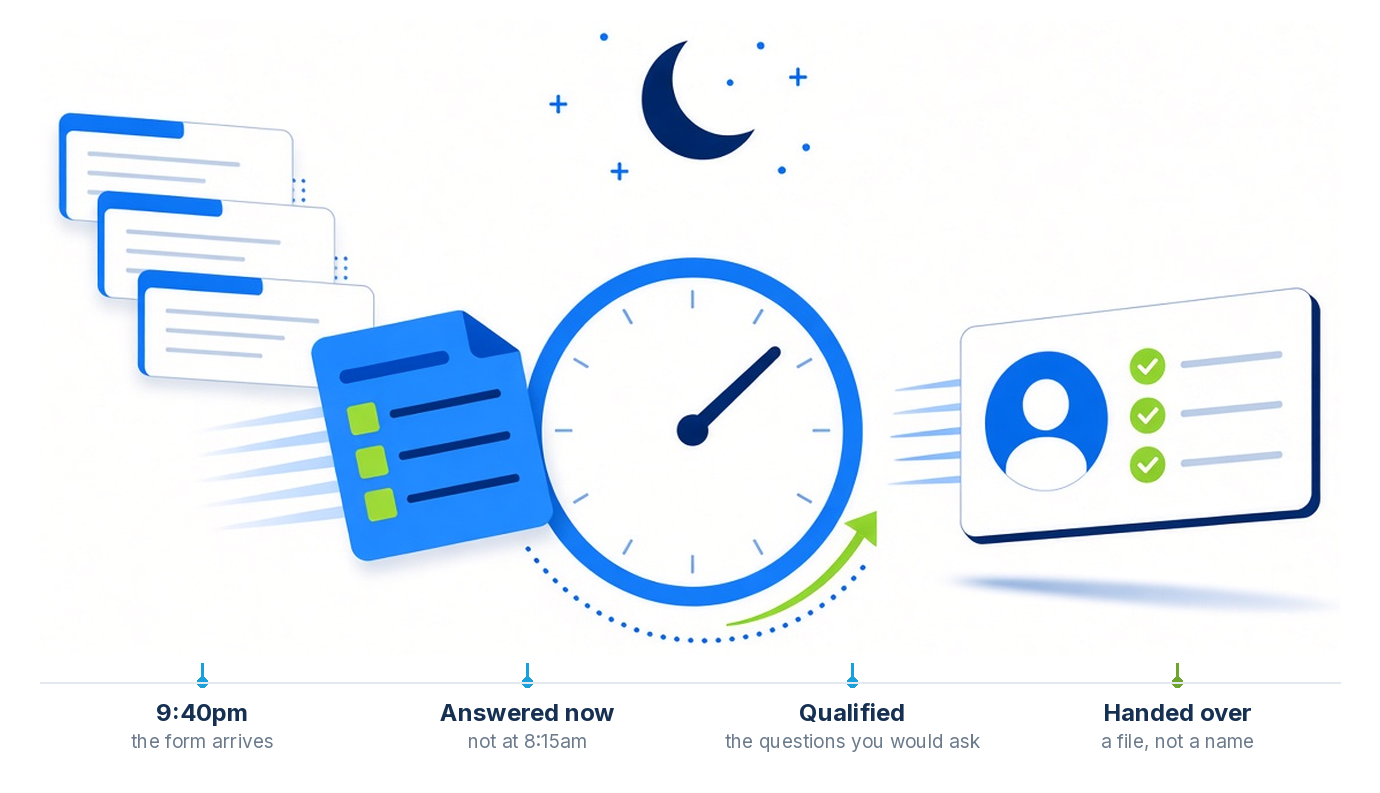
The 9:40pm form
Somebody is rear-ended on a Friday evening. They get home, their neck hurts, they are worried about work on Monday, and at 9:40pm they fill in the contact form on your site. Your intake coordinator sees it at 8:15 on Monday morning.
In between, that person filled in three more forms. Not because they are shopping around on price, but because nothing came back and they were anxious. Whoever answered first is now their lawyer.
This is not a hypothetical. It is the single most common pattern we see when a firm asks us to look at why marketing spend is not converting. The firm that responds first usually gets the client. Not the best firm on the list, and not the cheapest. The fastest one.
Why the form does not save you
The standard answer is to put more fields on the form. Capture the accident date, the insurance carrier, whether there was a police report, and let intake work from that on Monday.
Two things go wrong. Long forms get abandoned, especially on a phone, especially by somebody in pain. And the answers you get back are flat. A form cannot ask a follow up. Somebody types “back injury” and the form has no way to find out whether that is a strain from lifting a box at work, which is a comp claim, or a herniated disc from a collision, which is not. A human would have asked. Your form takes the two words and files them.
So you end up with a queue of half-qualified enquiries that all still need a call, which puts you back in the same race you were already losing.
What good intake actually does
Strip out the technology for a second and describe what your best intake person does on a call. They greet the person and settle them down. They ask questions that branch, so a workplace injury goes down a different path than a car accident. They check the answers hold together, and notice when a date does not fit a statute. They work out which attorney or which team this belongs to. Then they write it up so whoever picks it up next is not starting from zero.
Greet, qualify, verify, route, brief. That is the job, and none of it is exotic. The problem is that it only happens between nine and five, when one person is free, and only if the phone is not already ringing.
Where an agent earns its place
Workup Agent is our answer to this, and the distinction we care about is in the name. It is not a chatbot sitting on the site answering questions about your practice areas. It runs your qualification, in your order, with branching that adapts to what the person says.
A few things about it are worth knowing if you are comparing options:
It talks. Somebody with a broken wrist is not typing three paragraphs about their accident. They will say it out loud in thirty seconds. Voice is not a novelty here, it is the difference between a complete story and an abandoned session.
It knows what they were reading. Which pages, how long, where they arrived from. A visitor who spent four minutes on a workers’ compensation page and then opened the contact form should not be asked what kind of case this is.
It hands over a file, not a name. Your team opens a written summary of a conversation that already happened, with the qualification answers in it. That is a different Monday morning.
It does not get tired at 3am. Or on Sunday. Or in whatever language the person opened with.
What to measure once it is running
If you put anything like this in, track four numbers and ignore the rest for the first month. Time from enquiry to first meaningful response. Percentage of enquiries that arrive with complete qualification. Percentage that arrive outside business hours, which is usually higher than firms expect. And the number your managing partner actually cares about, which is signed cases per hundred enquiries.
The first number is the one that moves immediately. The fourth one follows it, with a lag of about a quarter.
It is not only law firms
We run the same thing on our own site. The questions are different, because qualifying a company that wants a Salesforce build is not the same as qualifying an injury claim, but the shape is identical. Somebody lands at an odd hour, the agent asks what our sales team would ask, and we open a real brief in the morning instead of a form submission that says “interested in services”.
If your firm is losing enquiries to the gap between evening and morning, that gap is measurable, and closing it is not a twelve month project. Send us your current intake questions and we will show you what the same conversation looks like when nobody has to be awake for it.